There are all kinds of librarians.
There are librarians who work for the government. For the military. For businesses. For colleges. For religious institutions.
There are law librarians. Music librarians. Art librarians. Film librarians. Medical librarians.
There are those who work in cataloging. Technical services. Circulation. Shelving. Reference. Archivists. Interlibrary loan. Library accessibility.
And many, many more types of libraries and library career paths.
And yet, whenever I'm at a conference, talking with a vendor or someone who has just found out that I'm a librarian, I always get asked the same question: "School or public?"
When I answer that I'm neither, that I am in fact, a synagogue librarian, I get a look as if I've said I'm a librarian on the planet Neptune.
I'm used to explaining what I do over and over and over (and if you'd like to know, you can read more about a typical day in my library here.) But here's when it gets frustrating. When I see awards or grants limited to certain kinds of libraries or librarians and restricted to others. I wish that me, my patrons and my library were eligible just like all the other libraries and librarians out there.
I value all kinds of libraries, librarians and library employees. I hope you do too.

Wednesday, February 24, 2016


Thursday, February 18, 2016
The Importance of Being a Mentor
The first time I attended an American Library Association (ALA) Annual conference I was completely overwhelmed. Which sessions should I attend? How was I going to fit everything into one weekend? How would I make any sense of this enormous association? I was attending graduate school at the time, didn't know anyone, and didn't know where to start.
I applied to the New Member Round Table (NMRT) conference mentor program and was matched with a librarian named Kris Springer. Kris met me on the first day of ALA Annual, at an incredibly early hour of the day, and explained to me how to navigate both the conference and the association. She told me about her experience on the Newbery Medal committee, and told me that I could one day be on a committee at that level. I got goosebumps and thought she was crazy. She helped me when I needed it and stayed in touch through the years.
It's now ten years after that first conference. I've been a conference mentor and a career mentor as much I've can. Sometimes officially through NMRT and sometimes unofficially when someone is at the start of their career and has questions. I've met with people I'm mentoring at conferences when I've had a loose schedule, and conferences where I've barely had a minute of free time. It's a priority to me and one of the most rewarding things I've done in my profession.
At the ALA Midwinter convention last month, I was so proud of all these wonderful librarians and so honored to have the privilege to watch how far they've come.
 For me, the most emotional moment was watching Amy Forrester. I met Amy several years ago when she was in library school and attending her first ALA Annual conference. I told her the things one usually tells a first time attendee; how to take the shuttle bus and to listen to all those people who tell you to wear comfortable shoes. Over the years, I watched her become a confident and skilled children's librarian. I was overjoyed when she was appointed to the 2016 Geisel Committee. It was really overwhelming for me watching the Geisel committee, which she was a part of, announce their choices to the world at the press conference. I am so proud that she and her committee recognized outstanding books for beginning readers and may have changed the lives of some of the creators and readers of those books. I wish you could have heard me cheering.
Thank you, Kris, for getting up so early a decade ago; for your advice and for the advice of all the other mentors who have helped me out. Thank you to all the people I've mentored- for being such wonderful professionals who I'm so proud of, for all I have learned from you, and for some inexplicable reason, listening to my advice.
I never realized that anything I was saying was helpful until I read this incredibly touching post from Amy Steinbauer. Thank you, Amy, for letting me know that I'm making a tiny difference. I'm looking forward to great things from you!
I hope this post inspires you to mentor someone in your profession. Whether officially and through an association, or by simply having lunch with someone new to the field, listening to their experiences and trying to answer their questions.
To all those children's and young adult librarians I have mentored, I look forward to the day when I get to watch your Newbery, Caldecott or Printz committees reveal their choices. I'll be cheering loudest!
I applied to the New Member Round Table (NMRT) conference mentor program and was matched with a librarian named Kris Springer. Kris met me on the first day of ALA Annual, at an incredibly early hour of the day, and explained to me how to navigate both the conference and the association. She told me about her experience on the Newbery Medal committee, and told me that I could one day be on a committee at that level. I got goosebumps and thought she was crazy. She helped me when I needed it and stayed in touch through the years.
It's now ten years after that first conference. I've been a conference mentor and a career mentor as much I've can. Sometimes officially through NMRT and sometimes unofficially when someone is at the start of their career and has questions. I've met with people I'm mentoring at conferences when I've had a loose schedule, and conferences where I've barely had a minute of free time. It's a priority to me and one of the most rewarding things I've done in my profession.
At the ALA Midwinter convention last month, I was so proud of all these wonderful librarians and so honored to have the privilege to watch how far they've come.
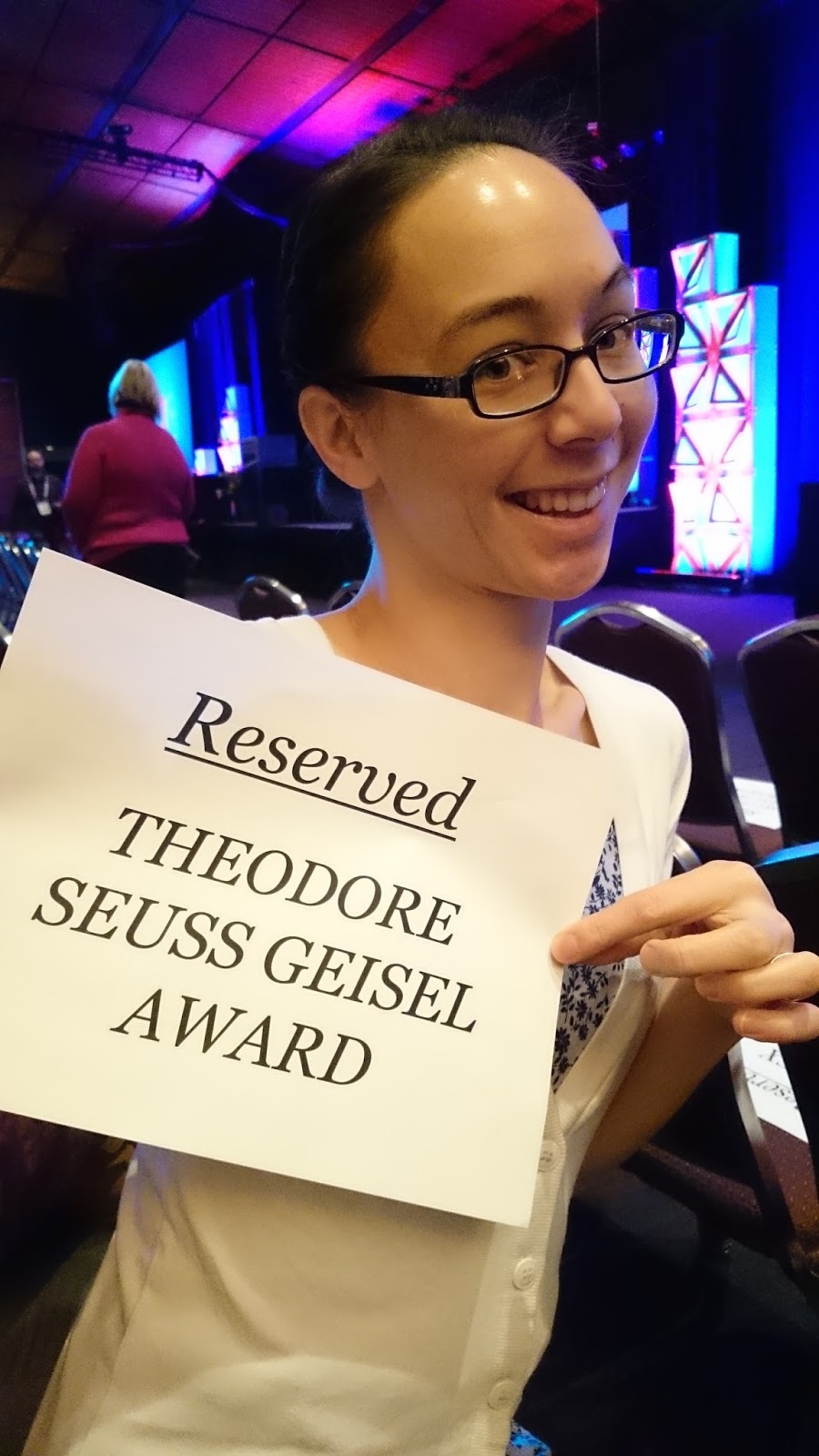 For me, the most emotional moment was watching Amy Forrester. I met Amy several years ago when she was in library school and attending her first ALA Annual conference. I told her the things one usually tells a first time attendee; how to take the shuttle bus and to listen to all those people who tell you to wear comfortable shoes. Over the years, I watched her become a confident and skilled children's librarian. I was overjoyed when she was appointed to the 2016 Geisel Committee. It was really overwhelming for me watching the Geisel committee, which she was a part of, announce their choices to the world at the press conference. I am so proud that she and her committee recognized outstanding books for beginning readers and may have changed the lives of some of the creators and readers of those books. I wish you could have heard me cheering.
Thank you, Kris, for getting up so early a decade ago; for your advice and for the advice of all the other mentors who have helped me out. Thank you to all the people I've mentored- for being such wonderful professionals who I'm so proud of, for all I have learned from you, and for some inexplicable reason, listening to my advice.
I never realized that anything I was saying was helpful until I read this incredibly touching post from Amy Steinbauer. Thank you, Amy, for letting me know that I'm making a tiny difference. I'm looking forward to great things from you!
I hope this post inspires you to mentor someone in your profession. Whether officially and through an association, or by simply having lunch with someone new to the field, listening to their experiences and trying to answer their questions.
To all those children's and young adult librarians I have mentored, I look forward to the day when I get to watch your Newbery, Caldecott or Printz committees reveal their choices. I'll be cheering loudest!
Tuesday, February 2, 2016
Caldecott-versary
Today is the one year anniversary of the day the 2015 Caldecott committee announced our winner and honors.
Things I have learned in the last year:
-You can walk into a windowless hotel room with fourteen acquaintances and walk out two days later with fourteen lifelong friends.
 -The only people who truly understand what you went through are the ones who were in that room with you.
-Forever (which is the length of time that you will be keeping your mouth closed about what happened during the deliberations) is a really long time.
-Getting to be on a phone call where you hear someone's life change is an incredible experience.
-It is challenging to go from one of the most intense experiences of your life and a crazy press conference full of celebration to driving a carpool the next day.
-Reading a New York Times article announcing the winner is enough to make you cry because you were in the room where it happened.
-You can't say if you voted for the winning book, but every single person will ask you if did.
-If anyone finds out you were on the 2015 Caldecott committee, they will inevitably ask to see your tattoo (which you didn't get).
-You should never read the comments section of anything that discusses your winners.
-The generosity, graciousness and appreciation of the winners will overwhelm and humble you.
-Having the ability to give away hundreds of books to a school that needs them is a wonderful feeling.
-Sitting in the front row at the banquet, seeing your name on the big screen and hearing your committee being thanked by the medal winner standing at the podium is a goose-bumpy and teary experience.
-Everyone in the children's book world is best friends with Dan Santat and they are all thrilled that he won the Caldecott Medal. (Seriously. Is there anyone who has only a casual acquaintance with Dan? How many best friends does Dan have?)
-The first Midwinter after you've been on the committee is hard. You know everything the committee is doing, and what time they are doing it, but you're not doing it too.
-If there are people left in the world who don't know you were on the Caldecott committee, your friends will make sure they find out.
-Being able to simply read and appreciate a beautiful picture book and not have to read it over and over and analyze it and tie yourself into knots writing a nomination for it is a nice thing.
-As overwhelming as it is to see your porch covered in boxes of submissions, you miss them when they stop coming.
-Reading the winning books to your own children is one of the most special feelings in the world.
-There is nothing like the thrill of seeing a Caldecott Medal on the cover of a book, and knowing exactly how it got there. It never gets old.
-Figuring out how to be vague in a blog post like this one is hard work.
Things I have learned in the last year:
-You can walk into a windowless hotel room with fourteen acquaintances and walk out two days later with fourteen lifelong friends.
 -The only people who truly understand what you went through are the ones who were in that room with you.
-Forever (which is the length of time that you will be keeping your mouth closed about what happened during the deliberations) is a really long time.
-Getting to be on a phone call where you hear someone's life change is an incredible experience.
-It is challenging to go from one of the most intense experiences of your life and a crazy press conference full of celebration to driving a carpool the next day.
-Reading a New York Times article announcing the winner is enough to make you cry because you were in the room where it happened.
-You can't say if you voted for the winning book, but every single person will ask you if did.
-If anyone finds out you were on the 2015 Caldecott committee, they will inevitably ask to see your tattoo (which you didn't get).
-The generosity, graciousness and appreciation of the winners will overwhelm and humble you.
-Fifteen minutes during lunch is not enough time to tell a group of fifth graders about the experience of being on the committee.
-Having the ability to give away hundreds of books to a school that needs them is a wonderful feeling.
-The first Midwinter after you've been on the committee is hard. You know everything the committee is doing, and what time they are doing it, but you're not doing it too.
-If there are people left in the world who don't know you were on the Caldecott committee, your friends will make sure they find out.
-Being able to simply read and appreciate a beautiful picture book and not have to read it over and over and analyze it and tie yourself into knots writing a nomination for it is a nice thing.
-As overwhelming as it is to see your porch covered in boxes of submissions, you miss them when they stop coming.
-Reading the winning books to your own children is one of the most special feelings in the world.
-There is nothing like the thrill of seeing a Caldecott Medal on the cover of a book, and knowing exactly how it got there. It never gets old.
-Figuring out how to be vague in a blog post like this one is hard work.
Monday, February 1, 2016
Hamilton

I hesitated in
writing this- because what is there to say about a show that is already a hit?
What is there that has not been said? I've tried to stay away, as
much as possible, from all the hyperbole. I didn't listen to the cast album. I
only read one review of the off-Broadway production. I wanted to find out about
it for myself.
My favorite
class in college, which I took my first semester because I couldn't wait any
longer, was a history of American Musical Theater. We talked about landmark shows
such as Showboat, Oklahoma, West Side Story and Company. If I was taking that
class now (or better yet, teaching it), I would add Hamilton to that list of game changers.
Why? It's not
enough that it's a hit.
It's easier to
like a show when the lines at the box office go down the street and the tickets
take a year to get... just as it is easier to like a book that already has a
Caldecott or Newbery Medal on the front. Someone else has already told us that
this is something extraordinary. The stamp of approval has already been
given.
What Hamilton
has done is to bring the rhythm of popular music back to the theater. The kind
of music that is playing in clubs and on the radio is now playing on Broadway.
How wonderfully refreshing. Broadway, which in recent years has been criticized
as elitist and apart from popular culture, is now being brought back into it.
But, Hamilton
is not all hip-hop or rap. It combines so many musical styles, often within the
same song, that it is mesmerizing. It would probably be a shorter list
to say which musical traditions are not in Hamilton, rather than the ones that
are. And the lyrics are brilliant, incredibly tight, interwoven and
multi-layered. And Hamilton is not a regular book musical, where there's a song
and then a scene, and back and forth. It's an opera. There are only a few lines
that are spoken without a beat or rhythm behind them. Call it a hip-hop opera
if you like, but an opera it is nonetheless.
If Hamilton
reminds me of anything, it's of another landmark show that is currently playing
in the Broadway theater next door. Les Miserables. Also an opera. Also
about a revolution, the difference between the rich and the poor, and breaking
into the ruling class. Also based on a very, very long book. (Hamilton is based
on an 800 page biography.) Also with a turntable- although Hamilton has a
double one. And there are echoes of the melodies of Les Miserables sprinkled
throughout Hamilton. Plus, if The Story of Tonight doesn't thematically
make you think of Red and Black, then I don't know what does.
The difference
between the two shows is that when I listen to Les Miserables, I always
feel as if I’m hearing the same song over and over. It seems as though there is
a melody that has been written to be used between major numbers, and the words
change but the tune stays the same.
Hamilton isn't
like that. There are 17 songs in each act (which is unusual, because the second
act is typically shorter) and each of these 34 songs are distinct, unique and
complex. There are musical patterns and phrases that are repeated, but not
whole songs and melodies. Compare that to when I saw Andrew Lloyd Webber's
show Whistle Down the Wind during an out of town tryout. All but one
song in the second act was a reprisal of a song in the first act.
The Hamilton
subject matter is incredibly intriguing as well. Here's a musical told from the
point of view of an often-overlooked Founding Father. Having been fascinated with Alexander Hamilton since ninth grade American History, I was happy to see him finally get his due. But while telling the story of someone who has been marginalized, it also has a
go at people such as Thomas Jefferson who are typically lionized. What an interesting change of pace. There is one historical question that the musical doesn't address, however- was Hamilton eligible to be President since he was born outside of the United States?
The references
are so far reaching and varied as to be astonishing. There's not a lot of
people who can quote the Lovin' Spoonful and then the Declaration of
Independence a few sentences later, as seen in the song "The Schuyler
Sisters." And as it takes Broadway a little further, it also refers back
to it. Gilbert and Sullivan's The Pirates of Penzance is directly
quoted, as is Rodgers and Hammerstein's South Pacific. Also,
Shakespeare, the Bible, Socrates, fairytales, and nursery rhymes. It's a
brilliant homage to what has come before.
I can't quite
remember when I first heard the name Lin-Manuel Miranda. I feel like I've known
about him for a long time. Obviously, through In the Heights and
the publicity and Tonys for that. But the thing that made an impression is this
video from his actual wedding which was circulating around on social
media.
This knocked
me back. Here was a talented Broadway actor who had gone to the trouble of
recreating one of Broadway's most famous songs, and a rather complicated one at
that, at his own wedding reception. Weddings are stressful events, with lots of
built-in craziness. He had clearly gone to a lot of effort while the events of
the wedding were swirling around him, to find time to rehearse, with
his future father-in-law, his father, with the bridesmaids and groomsmen. And
managed to keep it all from the bride. And it came off brilliantly. And paid
homage to Broadway.
Who is this guy?
Then I watched
the 2011 Tony Awards with the fantastic Neil Patrick Harris. What struck me the
most was the closing rap at the end, which summed up all the events that had
just occurred during the show. The performance by Neil Patrick Harris was
incredibly impressive, but I was amazed by the writing, which had great rhyming,
solid rhythm, funny jokes and heartfelt thoughts about Broadway tying it all
together. And it had clearly been done on the spot. I later read that Lin-Manuel
Miranda had been the one in the basement during the Tonys writing the closing
number.
Who is this guy??
A musical has
three parts that have to be written: the music, the lyrics and the book. The
division of labor varies depending on the creators. For Rodgers
and Hammerstein musicals, for example; Richard Rodgers wrote the music and
Oscar Hammerstein wrote the lyrics and the book. Stephen Sondheim writes the
music and the lyrics for his shows (with the exception of his first two), and
has collaborated with several different book writers during his career.
Usually, there is then another composer, called an arranger, who adapts the
music for different instruments in the orchestra. T here are only a handful of all the creators of musical theater who have been
able to write the book, music and lyrics all themselves, and have produced a
hit musical in the process. Meredith Wilson (The Music Man) is one. Jonathan Larson (Rent) is another.
One of the
many things that made West Side Story a landmark musical is
that it required the chorus to sing, dance and act. Before then, there were two
different choruses: the singing chorus and the dancing chorus. But now,
performers have to be triple threats, that is they have to master three
separate disciplines.
For Hamilton,
Lin-Manuel Miranda has written the book. And the lyrics. And the music. And
collaborated on arranging the music. Plus, he's the lead in the show. He acts.
He sings. He dances. He's a septuple threat. SEVEN disciplines. I can't think
of anyone in the history of musical theater who has done this
before. Not even him- for In the Heights he didn't write the
book or work on the arranging.

Something else impressed me about him. I've been to a lot of Broadway shows and seen a lot of stars. I've seen them race out of the theater after the show into waiting cars with police protection. Or sign a few programs of the people standing at the front and then call it a night. Not this guy. Lin-Manuel Miranda went the length of the entire line of people waiting to see him, in freezing weather, shaking hands, having conversations, and taking pictures with every single person including me and my husband. My camera jammed at exactly the wrong minute, he waited for us to fix it while everyone else was clamoring to talk to him and then took the picture himself. I imagine that he must go through the line after every show. What a mensch.
WHO IS
THIS GUY???
Whoever he is,
he's extraordinary. There's no doubt.
As
amazing as Lin-Manuel Miranda is, and it is obvious that the MacArthur
Foundation made an excellent choice, this is not a one man show. The
ensemble work is fantastic, with every actor and actress making memorable
performances. The off-stage talent is crucial, and the collaboration of the
director, designers, musical director, and choreographer comes together to make
the whole show a success. A perfect example of this are King George's songs. If
you only heard the cast album, you would think the songs were funny, catchy and
enjoyable. To understand how truly hysterical they are, you would have to see
Jonathan Groff's deadpan performance, Paul Tazewell's elaborate costume, Howell
Brinkley's lights that come in at the right moment and Thomas Kail's great
direction.

Even the marketing and publicity in Hamilton is notable. The primary logo is black- which means our eye is drawn to a lack of color. The color is completely contained in the gold background. Hamilton stands on the top of an iconic star from the American flag, which is missing its fifth point. Hamilton's body creates not only the star's final point, but also the letter A, his first initial. The images of Hamilton are everywhere. Not just on the marquee like most shows, but on the walls of the theater and the stage door. All over Penn Station. Inescapable, convincing us that Hamilton is the show to see.
If I could say anything to the people involved with Hamilton, or to someone who has won a Newbery or Caldecott Medal or otherwise achieved great success, it would be this. Try, as hard as you can, not to be encumbered by past success. Success can be just as paralyzing as failure. They don't all have to be life-changing hits. Just keep doing work that you're proud of. That's all anyone can ask.
I hope you get a chance to see it. Do not throw away your shot.
Saturday, January 23, 2016
Caldebutts
My young son loves The Adventures of Beekle: the Unimaginary Friend by Dan Santat.
And, for the first time, I'm going to be completely honest about why.
It's not the stunning artwork. It's not the incredible multi-layered story. It's not that I was a member of the committee that awarded it the Caldecott Medal. (WHY NOT??!! WHY ISN'T IT ANY OF THESE THINGS???!!)
It's the fact that you can see Beekle's butt.
Now, the casual reader probably only saw this Beekle butt, the main event.

But the true, careful observer can find a lot more than that with a little patience.
Here is a tiny Beekle climbing the tree.


 We also get a glimpse at Beekle's tuckus as he hands the paper to Alice, and in a later stylized version.


And it's the final image- on the back cover, as well as under the jacket.
Over the years, I have seen a number of posterior-related titles, starting with Captain Underpants, and in recent years titles such as Chicken Butt by Erica Perl and Veggies with Wedgies by Todd Doodler have crossed my desk. My son thinks these are brilliant works of art. They make him laugh harder than any other books on our shelf. Seriously.
The 2015 Caldecott committee set several records. The most honor books. The first graphic novel. And also, if you were paying attention, the first Caldecott Medal book (that I know of) featuring a butt. My kids are the proudest of this record.
Caldebutt scholars may argue for the inclusion of No, David! by David Shannon (featuring full nudity, no less!), In the Night Kitchen by Maurice Sendak and King Bidgood's in the Bathtub by Audrey Wood which certainly hints, if doesn't downright show anything. Those are honor books, and I'm talking about Medal books.
Now, Travis Jonker has pointed out, that to some, there is now a second Caldecott Medal winner that features a butt. This one is on the cover, no less. (I see knees). Look at Travis' post for more.
Thank you to Travis, for his post, that freed me emotionally to write this one, and to Angela Reynolds, my fellow Caldecott committee member, for the truly awesome title.
And, whatever the reason, I'm glad my son loves Beekle; no ifs, ands, or butts.
UPDATE: Alas, the 2015 Caldecott committee did not set the Caldebutt record after all. There's a great porcine posterior image in David Wiesner's Caldecott Medal book The Three Pigs. Who pointed this out? My son, of course.
And, for the first time, I'm going to be completely honest about why.
It's not the stunning artwork. It's not the incredible multi-layered story. It's not that I was a member of the committee that awarded it the Caldecott Medal. (WHY NOT??!! WHY ISN'T IT ANY OF THESE THINGS???!!)
It's the fact that you can see Beekle's butt.
Now, the casual reader probably only saw this Beekle butt, the main event.

But the true, careful observer can find a lot more than that with a little patience.
Here is a tiny Beekle climbing the tree.


 We also get a glimpse at Beekle's tuckus as he hands the paper to Alice, and in a later stylized version.

And it's the final image- on the back cover, as well as under the jacket.
Over the years, I have seen a number of posterior-related titles, starting with Captain Underpants, and in recent years titles such as Chicken Butt by Erica Perl and Veggies with Wedgies by Todd Doodler have crossed my desk. My son thinks these are brilliant works of art. They make him laugh harder than any other books on our shelf. Seriously.
The 2015 Caldecott committee set several records. The most honor books. The first graphic novel. And also, if you were paying attention, the first Caldecott Medal book (that I know of) featuring a butt. My kids are the proudest of this record.
Caldebutt scholars may argue for the inclusion of No, David! by David Shannon (featuring full nudity, no less!), In the Night Kitchen by Maurice Sendak and King Bidgood's in the Bathtub by Audrey Wood which certainly hints, if doesn't downright show anything. Those are honor books, and I'm talking about Medal books.
Now, Travis Jonker has pointed out, that to some, there is now a second Caldecott Medal winner that features a butt. This one is on the cover, no less. (I see knees). Look at Travis' post for more.
Thank you to Travis, for his post, that freed me emotionally to write this one, and to Angela Reynolds, my fellow Caldecott committee member, for the truly awesome title.
And, whatever the reason, I'm glad my son loves Beekle; no ifs, ands, or butts.
UPDATE: Alas, the 2015 Caldecott committee did not set the Caldebutt record after all. There's a great porcine posterior image in David Wiesner's Caldecott Medal book The Three Pigs. Who pointed this out? My son, of course.
Thursday, January 14, 2016
Sticker Shock
This week was big in the children's book world. Enormous. The American Library Youth Media Awards were announced on Monday, January 11th, giving out nineteen awards which included the Newbery, Caldecott and Printz.
Tuesday morning made me sad. Sadder than I want to admit. I picked up four major newspapers. Two omitted the announcement entirely. One buried it halfway through the lifestyle section and devoted three paragraphs, that were clearly all from the press release. And one put a few paragraphs in the back of the children's section, again mostly from the press release.
Now compare that to the Oscars.
NPR devoted three minutes of original reporting to it, which was a lot more than most, and for which I was grateful. Most of the articles that I saw that were original and well written came from trade journals, which were great but probably unlikely to be seen by the general public.
Not one talk show, of the endless numbers of shows out there who interview people and celebrities- had even a few minutes to spare to talk to these wonderful, witty, and charming award winners. Or even to talk about them. If you're aware of one that did, please let me know.
Yet, there was plenty of space for celebrity news and gossip.
Last year I was really crushed. I was on the Caldecott committee. Not everyone in my life could really wrap their head around what that meant, but I assured them it was important enough that it would be in the newspaper the Tuesday after the announcement. I said this for months during all the time when I was too busy reading and working on the Caldecott to have time for anything else. It's important enough, it will be in the paper, I kept saying.
Tuesday came. The Newbery Medal winner happened to be a local author (which was terrific, don't get me wrong) but resulted in my local paper, a major award-winning metropolitan newspaper, devoting their two paragraphs about the awards to him and ignoring the Caldecott completely. They didn't even have room for one sentence announcing the winner in an extremely newsworthy year when the Caldecott broke several records. The next day at work, all I heard was questions and doubt. It must not have been important enough. It wasn't there.
A Caldecott Medal winner once told me they received about nine press calls on the day of the award announcement. At the time I thought that was a lot. Nine calls.
But is it a lot? Think in broader terms. How many calls and interview requests does an actor who wins an Oscar receive? How about a quarterback who just won the SuperBowl? I'm willing to bet it's more than nine.
What's wrong with making our heroes and role models people who are talented writers, artists and book creators? Why are we telling our children that they have to read if we are not modeling and celebrating the importance of reading in our society? What kind of examples are we setting?
I'm hoping next year that Tuesday morning brings a ray of hope.
~~~~~~~~~~~~~~~~~~~~~~~~~~~~~~~~~~~~~~~~~~~~~~~~
If you saw an article from a major newspaper that featured original reporting and did more than quote a few sentences from the press release, please put a link to it in the comments to cheer me up. In fairness, some papers wait until their Sunday editions to do more in-depth stories.
In the meantime, I hope you read these great stories from Publisher's Weekly about the Caldecott, Newbery and Printz winners.
Monday, January 11, 2016
Q & A about the 2016 Newbery and Caldecott Medals
The
2016
American Library Association Youth Media Awards were very exciting in the
world of children’s literature. Boundaries were pushed. Records were set. And
you may be left with some questions.
Question:
How do you spell the name of that big award that is given every year for
the most distinguished contribution to
American literature for children?
Answer: Newbery. Newbery. Newbery. NOT NewBERRY. It is named for eighteenth-century
English bookseller John Newbery, and he only had one R in his last name.
Question: What won the
2016 Newbery Medal?
Answer: Last
Stop on Market Street, written by Matt de la Peña,
illustrated by Christian Robinson. It is 32 pages and it is a picture book.
Question: Wait; how did a PICTURE BOOK win the Newbery
Medal? I thought that
award was for novels. Isn’t the Caldecott Medal for picture books?
Answer: Both the Newbery
and the Caldecott
criteria define children as “persons of ages up to and including fourteen, and
books for this entire age range are to be considered.”
Picture books were always eligible for the Newbery. This is just
the first picture book to win. This also means that an illustrated book for
older kids, up to age 14, is eligible for the Caldecott.
Question: So what won? The words, or the pictures?
Answer: For the Newbery Medal- the words won, and the Newbery Medal will be given to Matt de la Peña, the author.
However, the ALA Youth Media Awards were very good to Last Stop on Market Street. It also won a Caldecott
Honor and a Coretta Scott
King Illustrator Honor Award. Both of these awards are for the art and will
be given to Christian Robinson, the illustrator. The book won three awards in
all.
Question: What won the
2016 Caldecott Medal?
Answer: Finding
Winnie: The True Story of the World’s Most Famous Bear,
illustrated by Sophie Blackall, written by Lindsay Mattick.
Question: I thought Sophie Blackall is Australian and Lindsay
Mattick is Canadian. Isn’t the Caldecott an American award? Wouldn’t that make Finding Winnie ineligible?
Answer: The Caldecott
criteria states "the award is restricted to artists who are citizens or residents of the United States. "
Since the Caldecott Medal is only given to the artist, not the
author- it is only the artist that needs to be eligible. So, it doesn’t matter
where Lindsay Mattick lives.
Sophie Blackall is currently a resident of the United States,
which makes Finding Winnie eligible.
Question: I’ve got more questions!
Answer: Ask them in the comments. I’ll try to answer them.
P.S. Newbery. One R.
To those that didn’t get a phone call today
I know you really wanted your phone to ring this morning.
I know you were hoping to be woken up by a happy speakerphone
full of people telling you how they had just changed your life.
I know you charged your phone last night, just in case.
I know you got excited when the phone rang, even if it was a
wrong number.
I know you waited until the press conference was over and all the awards were announced to be sure, because maybe they forgot to call.
I know you composed a rough draft of your acceptance speech in your head.
I know you won't admit to anyone how badly you
wanted it.
I know you tell people that you don’t really care
about the awards… because they are not why you make books for children.
I know that the phones of some of your friends did ring today
and that you’ll congratulate them for all you’re worth.
Maybe this was supposed to be your year.
Maybe all your friends told
you would win.
Maybe your book won all the mock awards.
Maybe your book won all the mock awards.
Maybe your book got a lot of starred reviews.
Maybe your publisher said it was a sure thing.
Maybe your publisher said it was a sure thing.
Maybe this was the book you’ve worked on forever.
Maybe you believed in this book more than any other.
Maybe it was close.
Maybe there were four phone calls and your book came in
fifth.
Maybe there were committee members who were deeply in love
with your book and fought for it, but the other votes just weren't there.
Maybe if different people were on the committee this year, the result would have been different.
Maybe if different people were on the committee this year, the result would have been different.
Maybe lightening just didn’t strike.
I hope your day comes and you get to hear the phone ring.
I hope you keep making wonderful books.
~~~~~~~~~~~~~~~~~~~~~~~~~~~~~~~~
For a few more award related posts from the perspective of someone who has been there: here's why I stopped predicting the Caldecott and Newbery Medal results and here's how book award committees differ from each other.
To vote for the ALA Youth Media Awards that made you the happiest today, see the poll on the sidebar.
~~~~~~~~~~~~~~~~~~~~~~~~~~~~~~~~
For a few more award related posts from the perspective of someone who has been there: here's why I stopped predicting the Caldecott and Newbery Medal results and here's how book award committees differ from each other.
To vote for the ALA Youth Media Awards that made you the happiest today, see the poll on the sidebar.
Saturday, January 9, 2016
What is like to be on a book award committee?
As we approach this year's announcement, our attention is focused on the big book awards such as the Caldecott and Newbery. But there are dozens of
awards of all shapes and sizes. After serving on a lot of award committees, I can tell you
that the experience varies greatly depending on the award.
Here's some of the questions I get asked a lot:
-Sometimes even if you could tell every single detail about the whole entire process, the award is so obscure that no one, probably not even the winning author, would be interested.
Here's some of the questions I get asked a lot:
How do you get on
the award committee?
-Sometimes you get nominated, and then selected by a
nominating committee to be on the ballot, and then win an election. Or you get
appointed by the head of the association to be on the committee.
-Sometimes you fill out an application and send in writing
samples.
-Sometimes you tell the chair of the committee that you’re
interested.
How do you get
eligible books to read?
-Sometimes they are sent in large boxes that arrive from publishers of all sizes on your doorstep full of hardcover, first editions of all the
books they’ve published that season.
-Sometimes they are sent in occasional envelopes from publishers and directly from self-published authors.
-Sometimes you spend countless hours in the library and
searching relevant databases and review journals desperately trying to find
eligible books.
How do you decide
on the winners?
-Sometimes everyone on the committee comes together from all
over the country, and are sequestered for several days in one room until they
emerge with the results.
-Sometimes you meet several times over the course of a year
for short meetings.
-Sometimes you use e-mail or Skype, but never actually meet
or talk to other committee members in person.
What do the authors
and illustrators think about being given your award?
-Sometimes it literally changes their lives. Sometimes it
lets them afford to be a full-time author or illustrator when they couldn’t
before. Sometimes they cry or exclaim in joy or are at a loss for words when you tell them they’ve
won.
-Sometimes they are honored and touched. They hadn’t heard
of your award before but they are delighted to be recognized and truly
appreciate it.
-Sometimes they don’t even know they’ve won until they
Google their name.
How does the
public find out about your list of winners?
-Sometimes they are announced with great fanfare at a giant
press conference in front of over a thousand people who scream and cheer while
others tune in to the big moment online from all over the country.
-Sometimes they are read at a small conference in front of
people who have never heard of any of the books on your list but applaud
politely at the end.
-Sometimes they are announced in a press release that you
send to everyone you know in the hopes that someone will notice your wonderful books.
How is the award
presented?
-Sometimes it is given at a beautiful banquet in front of people from every part of the children’s literature world, while the winner
gives a carefully crafted and lengthy speech, which is later published and studied by graduate students.
-Sometimes the winner speaks for a few minutes at an event
honoring many books and award recipients.
-Sometimes the winner gets the award in the mail.
What can you say
about the award process?
-Sometimes it’s all an enormous secret and you can’t breathe
a word of any of it. People hang on everything you say; even the tiniest
detail, and you can never, ever, ever let a real piece of information about
what actually happened escape your lips. Or else.
-Sometimes you can reveal why certain books won and why
others lost.
-Sometimes even if you could tell every single detail about the whole entire process, the award is so obscure that no one, probably not even the winning author, would be interested.
What remains the same?
-No matter the prestige of the award, book award committees are a lot of work. They involve reading and analyzing an enormous quantity of books, staying as impartial as possible, and making difficult choices.
-You have to work together with your committee and recognize that other people have different points of view. The book you love, others may hate and vice versa. It's not an individual decision but a group compromise.
-They help shine recognition on quality books for children and ideally get great books into the hands of readers.
Wednesday, January 6, 2016
Unpredictable
I used make predictions about which books would win the
Newbery and Caldecott.
I even got pretty good at it.
I even got pretty good at it.
But then, a crazy thing happened.
I got on the Caldecott committee.
To quote Into the
Woods: “I know
things now, many valuable things, that I hadn't known before.”
I know now that
until….
-your porch has filled with boxes of books that all have to be
read and evaluated carefully…
-you’ve spent a year reading during every ounce of time you
have, during evenings, weekends, during time you would have spent with your
family…
-you’ve read and analyzed every single book eligible for your
award to the best of your ability…
-you’ve weighed and debated over and over which books should
be nominated…
-you’ve carefully researched and written nominations with all
the intensity of a graduate school thesis…
-you’ve sat in a
room for hours and hours and hours and discussed books with people who knew
them just as well as you did….
-you’ve taken a
book you loved off the table…
-you’ve stared at a small piece of paper asking for your choice for the medal- and you knew that choice mattered….
-you’ve pushed
aside all the stars, mock results and commentary and voted for the books you
truly thought deserved to win…
-your committee
has reached a consensus….
-you’ve been on a
speakerphone call and heard the exact second when a person’s life changed
completely….
-you’ve held the
hands of the other committee members as your winners were announced and as the
crowd literally gasped at your decisions…
…. there are a
lot of things that are hard to know.
Now that I know
what these things feel like, I find it hard to second-guess the work and decisions
of someone else who knows too.
There are books
I like, books I love, books I hope will win… but I haven’t done the work these
committees have, and I haven’t read and studied the full field of eligible
contenders.
I wish the
members of all the America Library Association Youth Media award committees the
best of luck as they prepare for their discussions and decisions this weekend. You’ve
worked incredibly hard. Enjoy the phone calls and accolades!
And be sure to
read this on Sunday. It says everything I want to tell you the night before the
announcement.
I look forward
to applauding your choices Monday morning. I will try not to gasp.
If you'd like to follow me as I tweet live from the press conference, join me at @susankusel
Of all the prediction posts I wrote over the years, this one is my favorite.
Of all the prediction posts I wrote over the years, this one is my favorite.
Tuesday, August 28, 2012
Wonderful Wonder
A few months ago, I was invited to a small children's book preview event, where twelve authors were going to talk about their new or upcoming books. I tried to read as much as could before attending the event... I always like to be as familiar as possible with an author's work before meeting them.
 One of the books, Wonder by R.J. Palacio, only became available at my library the day before the event, so I found myself in my hotel room the night before with a long unread book. I figured I'd read the first chapter or two just to get a sense of the setting and the characters. I loved it. So I read another chapter. And another. Until it was four hours later and I'd read all 315 pages without stopping, writing down questions along the way. And then I just sat there in awe.
The next morning, I was surprised and delighted to find author R. J. Palacio sitting at my table. I told her how much I loved the book, and that I had a long list of questions to ask her. I think this put her off a bit, because it took her a few hours to start talking to me again. But she did- and we ended up having a lovely conversation. And she even answered all my questions.
I've waited a few months to post this because I wanted to let this book sink in. When I think about it, I can't help associating it with that mad, frantic rush I read it in. But really, Wonder is a book to savor and to enjoy over time. The craftsmanship, the exquisite turn of many a phrase, the humor, the way the author captures the essence of middle-schoolers... it's really something to slow down and appreciate.
I almost don't even want to tell you the plot because I don't want you to categorize or dismiss the book before you read it. Ostensibly, it's about a boy named August Pullman who has a facial deformity and who is starting public school for the first time. But it's really a lot more than that, and there's so much to learn as we see the world from Auggie's viewpoint.

The next morning, I was surprised and delighted to find author R. J. Palacio sitting at my table. I told her how much I loved the book, and that I had a long list of questions to ask her. I think this put her off a bit, because it took her a few hours to start talking to me again. But she did- and we ended up having a lovely conversation. And she even answered all my questions.
I've waited a few months to post this because I wanted to let this book sink in. When I think about it, I can't help associating it with that mad, frantic rush I read it in. But really, Wonder is a book to savor and to enjoy over time. The craftsmanship, the exquisite turn of many a phrase, the humor, the way the author captures the essence of middle-schoolers... it's really something to slow down and appreciate.
I almost don't even want to tell you the plot because I don't want you to categorize or dismiss the book before you read it. Ostensibly, it's about a boy named August Pullman who has a facial deformity and who is starting public school for the first time. But it's really a lot more than that, and there's so much to learn as we see the world from Auggie's viewpoint.
When it comes time to making my 2013 Newbery predictions, you can bet that Wonder will be on the top of my list. Whether it'll win or receive an honor is really dependent on this year's committee and the other books published this year. I'll be on the edge of my seat at the press conference on January 28, 2013 at the American Library Association Midwinter meeting in Seattle and I'll bet many of my colleagues will too.
The other award that many people have predicted Wonder will win is the Schneider Family Award which is given to an author or illustrator for a book that embodies an artistic expression of the disability experience for child and adolescent audiences. But as Palacio reassures us multiple times, Auggie's facial differences do not make him disabled. So the question is, will the book be considered as an embodiment of disability? Auggie does, however, have trouble hearing- and the issue of his partial deafness is dealt with in a funny and endearing way, so if the book does get recognized by the Schneider committee, it may be due to that.
I'd also love to see it win or get nominated for the National Book Award, particularly since most of the winners in the Young People's Literature category lately seem to be written for young adults. It would great to see a younger book win some accolades.
As most of you probably know by now, R.J. Palacio is a pseudonym. To learn more about the author (whose actual name is Raquel Jaramillo) click here for an article from Publisher's Weekly about her and how she wrote the book.
Random House has launched an anti-bullying campaign based on Wonder called "Choose Kind." There's more about it here.
Of all the books I've read so far this year, nothing has stayed with me like Wonder. Nothing else has made me both laugh and cry at the same time. It's a book I hope everyone has a chance to read.
Sunday, January 22, 2012
Last minute predictions
It's about eight hours until the announcement of the American Library Association's youth media awards. Excitement is in the air here at ALA's Midwinter Meeting in Dallas, Texas.
Who will the Caldecott? Who will win the Newbery? (Who will win the other 16 awards being handed out?)
Excellent questions.
I've been making predictions for the past several years, and I've got to say this is a particularly tricky year. Obviously, every year is completely up in the air, but some years are a bit more predictable than others.
This isn't one of those years.
I'll throw out some names for the Caldecott:
-Wonderstruck
-Blackout
-Me, Jane
-Balloons Over Broadway
-Grandpa Green
and some for the Newbery:
-A Monster Calls
-Inside Out and Back Again
-Amelia Lost
-Our Only May Amelia
-Breadcrumbs
-Shades of Gray
but honestly, I think it's anyone's ball game. I think it's going to be one of those years where the winners are announced, and everyone at the press conference whispers to their neighbor: "What? What was that book?"
You may notice that I left the presumptive Newbery favorite Okay for Now off my list. I think it's a wonderful but flawed book.... and while I'd be delighted to see it win, I just don't think it's going to make it. Also, I put Wonderstruck only on the Caldecott list, because I think the illustrations are far and away the strongest part of the book.
We shall see. It could very well be none of the ones I listed above. Whatever it is, I can't wait to find out.
Who will the Caldecott? Who will win the Newbery? (Who will win the other 16 awards being handed out?)
Excellent questions.
I've been making predictions for the past several years, and I've got to say this is a particularly tricky year. Obviously, every year is completely up in the air, but some years are a bit more predictable than others.
This isn't one of those years.
I'll throw out some names for the Caldecott:
-Wonderstruck
-Blackout
-Me, Jane
-Balloons Over Broadway
-Grandpa Green
and some for the Newbery:
-A Monster Calls
-Inside Out and Back Again
-Amelia Lost
-Our Only May Amelia
-Breadcrumbs
-Shades of Gray
but honestly, I think it's anyone's ball game. I think it's going to be one of those years where the winners are announced, and everyone at the press conference whispers to their neighbor: "What? What was that book?"
You may notice that I left the presumptive Newbery favorite Okay for Now off my list. I think it's a wonderful but flawed book.... and while I'd be delighted to see it win, I just don't think it's going to make it. Also, I put Wonderstruck only on the Caldecott list, because I think the illustrations are far and away the strongest part of the book.
We shall see. It could very well be none of the ones I listed above. Whatever it is, I can't wait to find out.
Subscribe to:
Posts (Atom)